



Jamie Fisher - 'Nobody Broke Your Heart: an Intimate Biography of Elliott Smith'
One of the greatest music biographies I've ever read. The book is sublime, loving, critical, investigative, analytical.

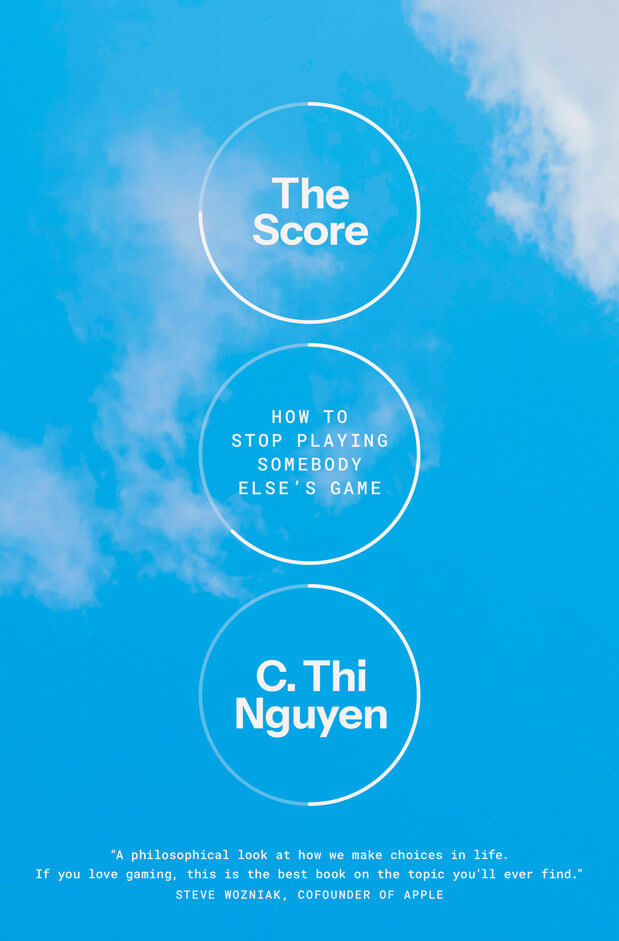
The author applies game theory to philosophy. The results are interesting from a philosophical perspective, but the book should have been heavily edited.
This may seem bizarre, but striving play is perfectly ordinary. Your friends come over, and you decide to play a silly party game, like charades. There is a paradox at the heart of charades. Most people play the game, not to win, but to break the ice and get goofy. But when you play charades, you have to actually try to win to have fun. A game like charades is fun only when you’re moderately invested—when you’re genuinely trying to communicate some silly little phrase through gestures, when you’re truly frustrated that people aren’t getting it. Getting emotionally invested in winning charges the whole experience, and gives it spice. But most of us don’t actually care about winning charades. If you lost but everybody had lots of fun, you probably wouldn’t feel disappointed. Because deep in your heart, you already know that winning isn’t the point. Having fun is.
Some paragraphs in the book, like this one, are good but could be more brief; to myself, the book could have been cut to half of its size due to waffling that should have been edited out.
Early in the book, the author states that chasing after ‘value’, something that is defined by measures, can be good in some forms of game, but adds it’s likely a terrible thing to do when it comes to work:
We don’t have a massive dataset for good art, but we do have a massive dataset for engagement hours. And this is no accident. Some kinds of things are systematically harder to measure because they are more variable, more personal, or more delicate. This is what a lot of this book will be about: why so many of the important things in life seem to consistently defy measurement. They vanish from sight when we insist on using the measurement tools of large-scale institutions and bureaucracy. What’s meaningful is intimate and unpredictable; it eludes easy classification. If we let institutional metrics set our values and drive our lives, we end up chasing what’s easy to count, and not what’s really important.
Another example shows how micromanagement and working according to predefined metrics can be very bad for work, especially because innovation becomes unlikely:
If experts in an institution know they will be rewarded for doing well on the metric and punished for doing badly, then they’ll be forced to take actions that advance that metric. Instead of using their own understanding of what’s important, they’ll be pushed to act on the public’s understanding of what’s important—at least when their actions are visible. But it will be even worse if the experts are value-captured by the transparency metric—if they start wholly substituting the metric’s simple target for their own richer understanding of what’s important. In that case, the expert will internalize the public’s limited understanding in the core of all their decision-making.
The basic structure of the book is this: details about one specific thing > example from the author’s life to clarify the thing > next thing. While the structure does serve a purpose, it quickly stops being droll and instead becomes dross, what I wanted to skip, especially when the author regurgitates terms that they’ve invented; we end up with examples like this one:
The methodology of transparency is accessibility. But accessibility is a double-edged sword. The demand for accessible explanations limits us to the kinds of things anybody can understand. If the value of the activity is subtle, then transparency metrics will miss the mark. And they will force experts to change their goals, to pursue unsubtle, obvious targets.
Some paragraphs and examples are elegant and serve a crystal-clear purpose:
Convergence doesn’t appear magically. It requires that we seriously muck around with what we’re evaluating. When skateboarding went professional—when it got sucked into the ESPN X Games and got connected up to big tournaments and big prizes—it started to change focus. Skateboarding in the tournament environment became less about flow, grace, and steeze, and emphasized the kind of achievements that are more obvious and countable: how high you can get and how many mid-air spins you can do. Importantly, competent judges may disagree deeply about which trick was loveliest or most original. But judges with basic competence will all agree about how many flips you did. Height and number of flips are easier to count publicly and together. This is why we can all agree that Tony Hawk was the first person to land a 900—a two-and-a-half revolution midair spin—but there is no record holder for the cleanest kick flip.
Then again, some sentences both sound as though they were written by AI and are impossible to penetrate:
Let me be clear here: I learned to cook from algorithmic recipes, and I never would have been able to get a start with cooking Japanese, Mexican, or Russian food without them.
What’s an ‘algorithmic recipe’? Is this written by AI? Many sentences are inexplicable:
These are among the truest heroes of striving play: the game modders, the indie tabletop role-playing-game hackers, the speedrunners. They are taking full control of the games they are playing.
In this example, the author doesn’t define ‘truest heroes’ nor ‘full control’. What’s the meaning of writing about ‘full control’ without defining what that is? Where does this leave the reader? In a land of confusion.
I think of and miss Verlyn Klinkenborg’s wonderful style book Several short sentences about writing.
This book is worth reading in spite of my gripes. I like how the author brings positive human values to the fore, along with the importance of experimentation, playfulness, and how ‘value’ in work should rarely be measured in sheer rote work, especially by continuously checking a predefined number of boxes.
One of the greatest music biographies I've ever read. The book is sublime, loving, critical, investigative, analytical.
A impassioned, needed, and arrhythmic book about a groundbreaking record label and its great artists and producers.
A messy collection of memories from a life as a music lover, a punk musician, and a music writer.